5e vs 5.5e
What I use, what I don't and why
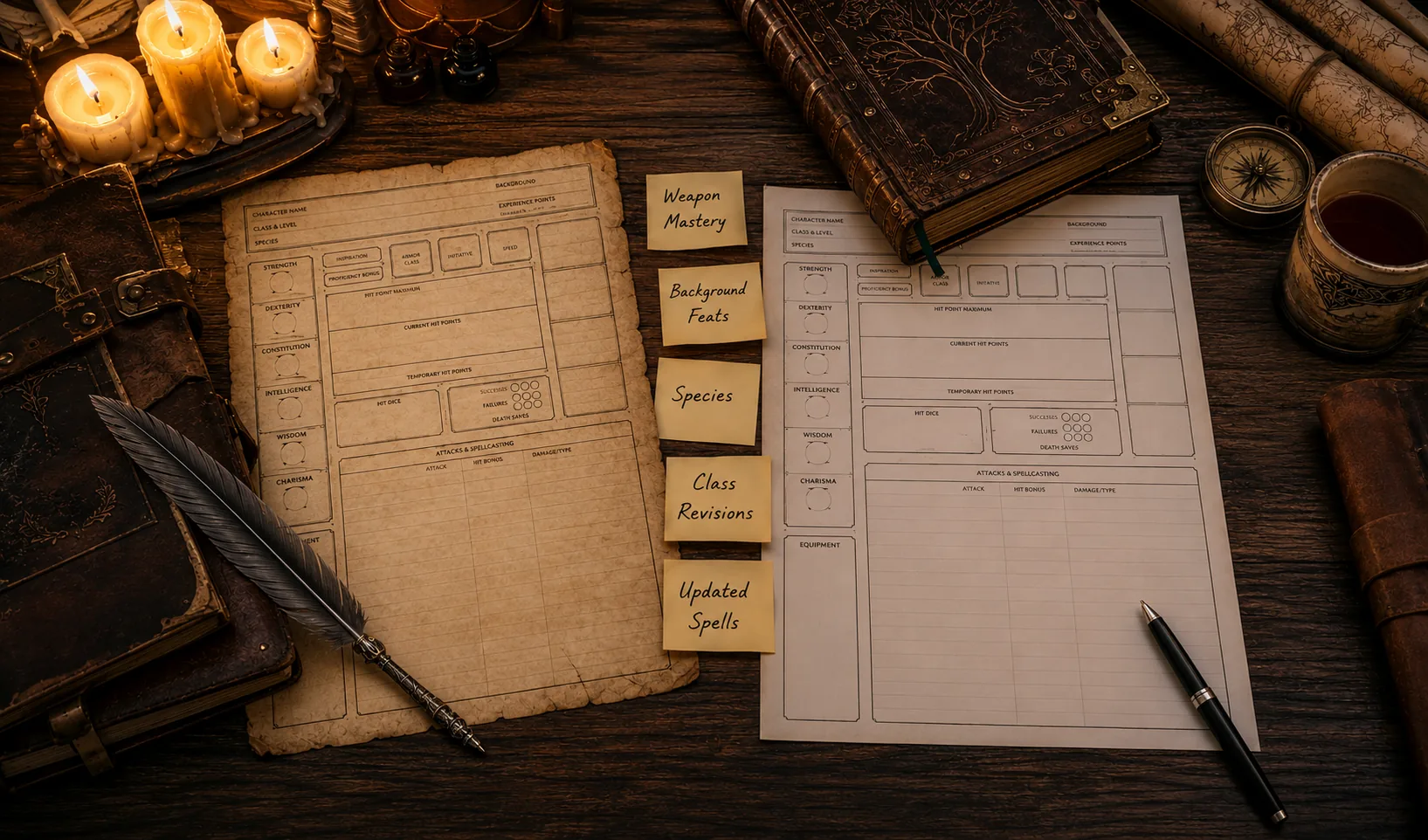
I’m playing catch up a little bit since I started this blog about 2 years after Wizards released the revised core books (Player’s Handbook, DM’s guide, and Monster Manual). It’s still worth talking about though because while there are a lot of really nice quality of life improvements there are a few things I don’t love and choose not to use.
I’ve been running a mostly-5.5e homebrew campaign for the better part of a year now, so most of what follows isn’t me reading a book cover to cover and reporting back. It’s stuff I’ve actually played or ran at the table, for better or worse. Wizards of the Coast never called this “5.5e.” My group of folks have gone through a few different iterations of other names like 5R (for revised), 6e lite, 5E2024, etc. but I think we all knew it would end up as 5.5 which is what the community adopted at large and that’s probably for the best. Since it is officially a revision, not a new edition, everything is built to stay backward-compatible with everything from the last decade, although I wouldn’t recommend using almost anything from 2014 in combat against 5.5e PC’s.
The important thing going in is that this isn’t a from-scratch overhaul like going from 3.5 to 4th edition. It’s closer to a very thorough patch. Most of your 2014 books still work fine at a 5.5e table. But there are enough reworked rules, stat changes, and class overhauls that running a game feels meaningfully different, especially for classes that got very little love cough cough… ranger cough cough.
The Reworked Rules
The single biggest learning curve is Weapon Mastery, and it’s the one change I’d point to if someone asked me what’s actually new here. Some of these were reworked from the RME (revised martial equipment) 3rd party supplement, some were house rules that got pretty widely adopted, and some I had not heard of at all until the new books. In 2014, a greatsword and a longsword were mechanically almost identical outside of damage die size — pick whichever fits your character concept and move on. In 5.5e, martial classes get a mastery property tied to the weapon itself: Cleave lets you swing into a second adjacent enemy, Topple can knock a target prone, Vex sets up advantage on your next hit against the same target, and so on. You can swap which weapons you’ve mastered during a long rest, so it’s not a permanent choice, great addition for players but makes my life as a DM more complicated. It’s a small thing on paper, but it gives martial characters actual decision points in combat instead of “I attack” on repeat, and that’s the kind of thing that you hear every combat and commit to memory quickly. If you are a martial and you aren’t using this, do yourself a favor and read your character sheet or ask your DM how it works!
Race got renamed to Species, and it moved ability score increases to your Background instead, along with your starting languages and some of your tool proficiencies. Species is left to handle the stuff that’s actually about being an teifling or a dragonborn like darkvision, resistances, that kind of thing. I like this change quite a bit as a DM, because it gives more of a character choice grounded in the story rather than min/maxing a build. Backgrounds went from an afterthought to something players actually think over and use; in 5e there were so many times that I put in a hint for a clue to a location or puzzle specifically to get them to use a background feature they didn’t know they had 95% of the time.
Long rests got some attention too, and it’s a mixed bag depending on how your table runs. It’s harder to just chain rest-rest-rest through a dungeon now — there’s a real-world gap required between long rests — but getting interrupted mid-rest is far less punishing than it used to be. In 2014, one goblin poking its head in negated the whole rest RAW. Now you can pick the rest back up, you just tack on an extra hour. Granted my tables already implemented the 5.5 “piece-meal” style long rest so it’s just fully official now. You also recover all your hit dice instead of half, which matters more than it sounds like at low levels or if you are crawling a dungeon and need to short rest to top up HP. This part was a new addition to my table but the nice thing for me is when we do get to a proper dungeon I get to throw more difficult challenges at my players the whole time [insert evil DM laugh].
Exhaustion got simplified from a six-step chart nobody at my table could ever remember past level 2, into straight math: each level of exhaustion is a flat -2 to every d20 roll and -5 feet of speed, stacking up to level 6, which kills you. For my table I actually choose to use the OG 5e exhaustion because it is so much more devastating over time and adds stakes to the story for taking levels of exhaustion. If someone chooses to stay up to work on something important or is forced into a situation that they have to stay up or face a set back on a goal that is life or death stakes! That is a great storytelling device.
Inspiration became Heroic Inspiration, and this is probably going to be my hot take... I am not a fan of having inspiration being built in as a given mechanic for humans every long rest. It did officially change from being advantage on a roll to a reroll after seeing the result which I already used it that way so no big deal there. My two strong opinions here are that inspiration should come from something that rewards fun, creative, or exceptionally cooperative gameplay or story choices instead of given out very liberally. The other opinion is related to the other big change to inspiration in that you can give it away to someone else (which I as a player always did when allowed by my DM in 5e because I didn’t use it) failing is fun and good for the story!!!
The Stat Changes
The math changes are smaller individually but add up. Cure Wounds and Healing Word both heal for roughly double what they used to at the same spell level, which was a necessary fix — healing spells were embarrassingly weak compared to just hitting things harder. It was advantageous mechanically to wait until someone was unconscious before popping them back up with a heal because attacking was just a more effective way to keep people alive… Clerics are the classic healer but it if you wanted to get the most out of playing one it made way more sense to say “the fastest way to stop you from dying is triage while I spirit guardian and guiding bolt the creature who is trying to kill you”. Potions can now be drunk as a bonus action instead of your whole action, which is another WIDELY adopted house rule from 5e. I actually can’t think of one time in nearly a decade of playing that anyone used the RAW for healing potions.
The Player’s Handbook also picked up somewhere around 30 new spells on top of the rebalances, though honestly, most tables aren’t going to notice that number so much as they’ll notice specific spells hitting differently than they remember. This brings us to my next major hot take on 5.5 changes… it's one spell in particular that I absolutely refuse to use the updated rule for… counter spell.
In 5.5e it is simplified, which for a lot of tables is a nice change, less interruption of the flow of combat and easier for people to pick up quickly. The way it works in the revised rules is the caster of the original spell makes a constitution saving throw, if they fail the action/bonus action/reaction is used but the spell slot isn’t expended.
In 5e counter spell works automatically to negate any spell 3rd level (or whatever level you cast counter spell at) or lower, for countering spells at levels higher than the one the counter spell caster spent you can roll an ability check of 10+ the original spell’s level. So choosing what level to cast at becomes a huge decision, it can either hit right on the exact level or you can burn a higher level spell slot and still have to roll to have take effect but possibly fail. Whatever the outcome the original caster will have expended a spell slot.
In my opinion, 5e rules are higher stakes and higher reward. You can counter a 9th level spell with a 3rd level slot with a roll or you can use a 9th level spell to have it work no questions asked. If the mage has a couple lesser mages waiting in the wings hidden to throw a couple wrenches at your party’s wizard when he tries to cast his opening fireball and he burns a spell slot the party is going to be pretty motivated to get to them and take them out quickly. My personal favorite though, if you want to make it overwhelmingly obvious that your big bad is a vile opponent, use counter spell on healing spells to bring party members back up to from unconsciousness. Again, I think that the earlier version of rules creates a more engagement for the players into the story.
Classes That Got a Facelift
Monk got the most dramatic overhaul in the whole book, and it needed it. Ki Points are now Focus Points (name only, don’t worry), the Martial Arts die scales up faster, Deflect Attacks finally works against melee and not just ranged attacks (although deflect missiles has a particularly cool visual aesthetic to me). Patient Defense and Step of the Wind both got quality-of-life buffs. The one nerf in the mix is Stunning Strike, which got noticeably harder to spam which is nice on the DM side of the screen but if you’ve played a Monk that trivialized boss fights by locking down the BBEG turn after turn, that’s the one they came for.
Ranger was probably the class most people agreed needed help, and 5.5e actually delivers. Hunter’s Mark is now always prepared for free and can be cast twice without burning extra slots, and Natural Explorer got replaced with Deft Explorer, which trades bonuses for traveling through situationally useful terrain for Expertise and a couple of extra languages. It’s not flashy, but it fixes the actual complaint people had, which is that half the Ranger’s identity was tied to features that never came up at the table.
Barbarian’s Rage got a little more forgiving; it lasts longer, and you can extend it with a bonus action if there are any tables that full of accountants but it’s never come up in my experience. At level 9, Brutal Strike gives you the option to trade away the advantage from Reckless Attack for a rider effect instead, a nice bit of choice in a class that’s historically been pretty simple: rage, hit, repeat and they didn’t change that much so it remains a remarkably easy class to pick up and play effectively without much reading.
Fighter’s headline change is the one already covered above — Weapon Mastery is basically built around them, since they get access to more mastery properties than anyone else as they level. Worth noting too that Psi Warrior, which started life in Tasha’s Cauldron of Everything, is now one of the four core Fighter subclasses in the Player’s Handbook itself, alongside Champion, Battle Master, and Eldritch Knight.
Wizard’s changes are subtler but genuinely useful at the table: you can swap out prepared cantrips after a long rest instead of being stuck with your level 1 choices forever, and starting at level 5, Memorize Spell lets you swap a prepared spell on a short rest. It’s not flashy, but it makes the class feel less like a permanent build decision made in one sitting at level 1.
Rogue picked up Cunning Strike, which lets you trade a die of Sneak Attack damage for a rider effect instead — poison the target, trip them, or hit and disengage without eating an opportunity attack. Combined with more uses of Expertise than before, Rogues have more to actually decide on their turn beyond “I sneak attack again.”
Paladin is the one class with a genuine trade-off instead of a straight buff. Divine Smite is now Paladin’s Smite, and it works as a bonus action rather than something you tack onto a hit after the fact, which means the old trick of stacking multiple smites onto one massive crit is gone... As a paladin Stan I will miss the nuclear amounts of smite damage without worrying about wasting spell slots. In exchange, Channel Divinity got a real buff: two uses a day instead of one, recharging on a short rest, plus a new Abjure Foes option every Paladin gets access to. I think it is a slight nerf but on the DM side of the screen it’s probably a good thing. It’s hard for me to be purely objective about my awesome smite folks though, if/when a player at my table wants to use 5e smite rules I’ll fold like a cheap lawn chair.
Sorcerer finally prepares spells the way other full casters do starting at level 3, which quietly fixes years of Sorcerers having embarrassingly few spells known compared to a Wizard’s whole spellbook. Innate Sorcery gives you a temporary window of advantage on your spell attacks and a DC boost, which scales up again at level 7 and level 20.
Warlock remains the least changed. It gets more Eldritch Invocations and gets them earlier, and you can modify more cantrips that just eldritch blast… but let’s be honest here… it’s still going to be eldritch blast. The great thing about more invocations is even more customization and flavor. The strength of warlock mechanically has been spell slots coming back on short rests but the really fun thing about warlock has always been flavor! They are a DM’s plot hook dream for any number of incredibly powerful beings to have direct access to the party in a variety of creative ways, whether it’s an Archfey, a Fiend, or an incomprehensible eldritch horror from beyond the realms of reality itself. From the player’s perspective, they have a built in motivation for exceptionally foolish or heroic things and often both.
Bard and Druid both got quieter but meaningful reworks. Bardic Inspiration now lasts an hour instead of ten minutes and can be applied after you see a roll fail instead of before, which removes almost all the “wait, should I give it to you” guessing games. Wild Shape got rebuilt from the ground up into a bonus action with a short, swappable list of prepared forms, and Druids can now just talk while shapeshifted, which solves a decade of “how does the Druid communicate as a bear” table arguments.
The Bottom Line
If you are already using 2014 rules, chances are you have some house rules you already use and 5.5e gives you some useful options to add in. Classes are better across the board (mostly… I still want to nuke things with smites but I am very biased). Ranger is significantly better and monk got some QOL improvements on both the player side and DM side.
If you are just getting started 5.5e is the easier route and will save everyone time learning the system but don’t be afraid to deviate from rules as written (RAW). If something doesn’t feel like it’s working quite the way you think it should or it doesn’t feel like fun or challenging for whatever reason you can change it so that it is fun. Rules as intended and the Rule of cool are always there to use as needed and I personally encourage them if it better serves the story.
You are probably noticing a theme, in that the reason I choose to use or ignore certain things is mostly based on what best serves the story. At it’s core I believe that D&D is really just imaginary story time we play with our friends and we added a framework to it. That’s all it is, that is why it’s fun. We as people love stories, it is how we have passed down information from generation to generation, it can give us insight into our lives or others lives, it can help us understand situations in ways we previously didn’t. From cave paintings to philosophical allegories, there is an innate human desire to tell stories… also dragons are cool. Ultimately, 5e and it’s bigger, younger brother 5.5 technically have rules, but you and your table can choose what you like or don’t like and use what you want to. The only rules that matter to me and my table are that we all have a voice at the table and we all should be having fun. It’s really that simple.
Don’t forget to love each other,
Kyle