Cosmology of D&D Part 1
The Material Plane's mirrors: the Feywild and the Shadowfell
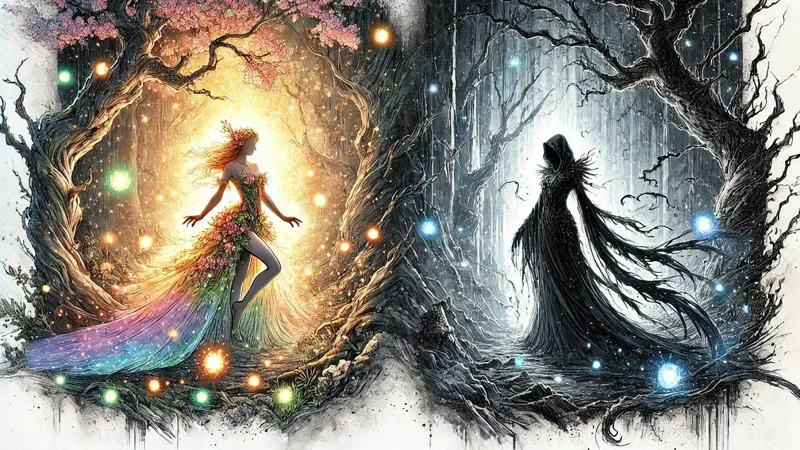
The planes of D&D can feel massive, even overwhelming when you try to relate it to our own reality. That is one of the things that makes fantasy feel so much larger than life. The problems of the “normal” person on the material plane can be enough to fill years of playing through a campaign, whether you are navigating the difficulties of traveling the world, scraping together enough gold to retire, or navigating the complexities of the political landscape. Adventurers are rarely anything less than extraordinary, however. They often deal with multiplanar threats such as Fey, Devils, Demons, Elementals, and sometimes even demi-Gods or aspects of the Gods, and these beings can make your players’ characters actually feel larger than life.
In order to keep everything organized and digestible, I’ll be separating these posts into parts sorted by relative party level. To utilize these places and beings you don’t need to know every intricate detail of the entirety of the cosmology, but you do need an idea of where they are, how they typically operate, and when your players’ level is appropriate to interact with other planes without a high risk of a TPK.
To bring everything into a bit more of a pragmatic view from a DM perspective of when to use them at your table, let’s look at the planes by character level:
The Hometown Heroes 1st-5th level: Bandits, mysterious happenings, and the call to adventure.
National Treasures 6th-10th level: Fey wandering through high magic areas, Shadowfell creatures slipping through thin parts of the veil, and elemental rifts opening in remote regions.
Global Renown 11th-16th level: Interplanar travel, fighting fiends and devils, seeking divine artifacts.
Mythical Figures 17th-20th level: Traverse the Astral Sea, confront high-ranking Devils, do battle with ancient dragons, or challenge threats that span multiple planes.
Starting with the planes that are closest to the material plane, the Feywild and the Shadowfell makes the most sense because running into Fey creatures or ghosts is relatively common in most campaigns. I’ll go into the most detail on these, as campaigns will probably spend more time with these two than any others (with the exception of perhaps the Nine Hells). The mirror planes are direct reflections of the material plane, so navigating them geographically is pretty straightforward. The denizens of the planes are another story entirely.
The Feywild has a lot of things that are going to be somewhat familiar, such as elves, but it is like the entirety of the world is turned up to eleven. Think extremely intense emotions, overflowing with magic, whimsical chaos, and grim fairy tales. The elves of the Feywild are called Eladrin, and their physical appearance is a manifestation of where they live. The plane is divided into four seasons: summer, autumn, winter, and spring, which manifest as different emotions as well. Summer is fiery passion and lush fields; its mirror, winter, is characterized by cold melancholy and preservation. Spring is a place of rebirth and new starts, hope and budding new life; autumn is a time of transitioning toward twilight, harvest, and enjoying the slower season. For the sake of some semblance of brevity, I won’t get into Seelie and Unseelie politics of the Fey.
There are many things to be wary of in this plane. Fey bargains, hags, and even the environment itself has a magical life to it that must be respected. The warnings of fairy tales here are all too real, and words are not meant to be taken lightly. Words have power, names have power, and even accepting something we might take as a gift such as food, without explicit confirmation that there is no price to be paid for it, can enter a player into an unwitting but very binding contract.
Getting to the Feywild is usually less a matter of arcane acumen and more a matter of finding the right place at the right time. Crossings tend to form where the boundary is naturally thin: fairy rings in old forests, crossroads at dusk or dawn, moonlit paths that weren’t there the day before, ancient stone circles, or any place where powerful emotion has soaked into the land. Players might step through without realizing it, wandering into a woodland glade only to notice the colors are too vibrant and the songbirds are singing back to them in their own voices.
Fey are probably the most common to be found by some circumstance or another in the material plane, since the veil between the material plane and each of the mirror planes is the thinnest of any planar boundary, and Fey beings have a tendency to be on the more chaotic side of things. In areas of highly concentrated magic, deep in forests, or sometimes even just wandering about curiously (or as a convenient plot hook), players can happen upon the Fey folk.
A final important note, and a VERY either convenient or inconvenient one depending on how you choose to implement it: time in the Feywild behaves differently than on the material plane. You can choose to have time in the Feywild operate either faster or slower relative to the material plane.
I typically choose to have it operate faster in the Feywild for two practical reasons. First, it acts as a place the party can hop into when the opportunity presents itself, letting them take care of whatever Fey business they need to without vastly impacting whatever else they have going on on the material plane. Second, it takes a significant amount of prep work off my plate as a DM. Minimal time changes on the material plane are a lot easier to manage than thinking through what a jump ahead in the timeline across an entire world would entail, with presumably fairly significant loose ends from the party’s adventuring.
If the Feywild is a movie in 3-D technicolor, the Shadowfell is a black and white film shot on 35mm. Things here are bleak, dreary, muted, and morose. There is no sun, moon, or stars, but a grey light permeates the plane, along with an eternal fog that gives everything an eerie and limited visibility. The inhabitants generally succumb to hopelessness and despair that borders on severe depression. Where there was vibrant and lush plant life in the Feywild, the flora and fauna here is minimal. Only plants that can survive extremely harsh conditions have a chance at survival.
Magic in the Shadowfell is sparse as well, making it relatively easy to find your way in from a plane with much more magical energy, but finding your way back is much more difficult. A portal to the Shadowfell can form in any area steeped in death and out of direct light. The return trip, however, requires creating a very high level of magical concentration due to the inherent lack of magic here.
Much like the Feywild, the Shadowfell is home to its own unique race of elves called the Shadar-kai. They are loyal to the Raven Queen, a lawful neutral goddess of death, fate, and winter. The Raven Queen was once a powerful elven queen who attempted to ascend to godhood, but the ritual was corrupted by evil wizards who were meant to be helping her. Despite them trying to siphon her power, she was too powerful to be destroyed, and she and the Shadar-kai who were devoted to her were bound to the Shadowfell. The Raven Queen has one of the only buildings of note that is consistent in the plane, her Fortress of Memories. Here she stores memories, trinkets, and treasures that are tied to strong emotions. She also has no physical form, so she may only experience the world through the eyes of ravens or her Shadar-kai.
Another notable structure is known as The Spire. Everything within a mile radius of the tower acts as an anti-magic field. The true purpose of The Spire is unknown, but it is used for clandestine meetings, since the natural anti-magic ensures that no scrying or other nefarious magical means of surveillance can occur.
The Shadowfell’s most infamous city is Evernight, a shadowy reflection of a bustling material-plane metropolis where the undead outnumber the living. Streets that would be crowded with merchants and travelers on the material plane are instead prowled by ghouls, wights, and worse, all going through lifeless motions of the routines they held in life. The living residents that remain keep their heads down, pay their tolls in blood and memory, and try not to draw attention. Evernight is the epitome of Shadowfell tone: familiar enough to be unsettling, wrong in every way that matters.
The only trading hub of note is the harbor city of Gloomwrought, which caters to planar travelers and specializes in rare magical components, particularly those needed for certain necromancy spells (great potential plot hook by the way).
The Shadowfell is also home to the Domains of Dread, which I touched on in the Ravenloft: Horrors Within post last week. I’ll do a deep dive into various domains of these pocket dimensions that house the exceptionally powerful dark lords in a future post closer to spooky season.
Both the Feywild and Shadowfell fall towards the upper range of the 6th-10th level tier for when players are well enough prepared to be going to either of these places, because the types of adventures that involve going to even the closest planes can be very difficult to navigate. Most campaigns don’t typically go much further than 10th level, and having an interplanar-level threat will end up making a fantastic final bad guy.
The effort of getting to another plane can be a monumental challenge. Perhaps the party must gather a nation’s most powerful mages to focus enough arcane power to even open a portal, and from there have to navigate a strange plane with nuanced customs, bringing back the feeling of being a new adventurer again just to get in a position to solve whatever planar incursion is occurring. This is an opportunity to take heroes who have grown to a point of feeling like they have the world figured out and drop them into a place where they are fish out of water, where even their exceptionally powerful abilities meet difficult stakes and threats that feel potentially reality-breaking. Whether you’re going for chaotic and whimsical Fey tones or a sinister and gloomy flavor, there is a lot of material here to draw inspiration for puzzles, curses, and epic adventure that is just a portal or planeshift away!