Old Gods Bootlegger Tunnel Run
A 5.5e endurance encounter designed by accident
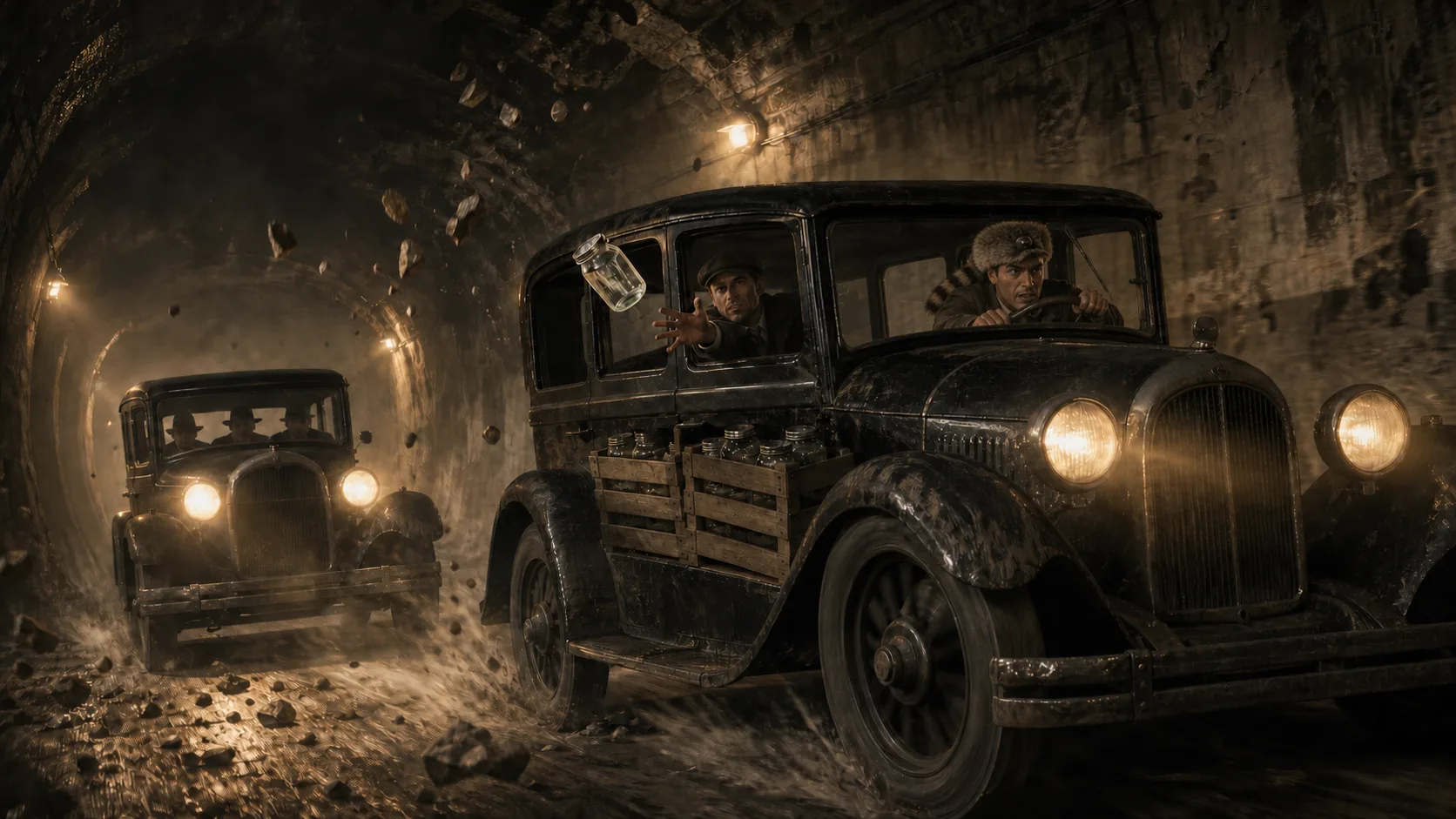
An offhand offer to help with a bootlegging run turned into a two-session endurance encounter and sent the entire campaign off the map. It started as a possible way to retire one character. Instead, every player took the offer.
An endurance encounter is a long chain of smaller encounters and skill checks designed to slowly drain HP, spell slots, class features, and other resources. The challenge does not come from any single roll. It comes from deciding what to spend now, what to save for later, and how long the party can keep moving without a safe rest.
What makes these types of encounters particularly effective is removing some of the meta-game strategy and leaving it down to rolls. I made sure it didn’t feel like I was engineering a narrow escape by having the players roll the random encounter checks themselves. I was still responsible for building and balancing the table, but the players knew I wasn’t putting a finger on the scale. When the worst-case scenario appeared more than once, they had to get creative or survive with whatever resources they had left.
One caveat before getting too far into the details, this was used for my home game which is based off of the Old Gods of Appalachia sourcebook from the podcast of the same name in collaboration with Monte Cook Games. It is a horror themed game set in an alternate version of 1930s Appalachia and I have home brewed it pretty liberally as well but a ‘34 Plymouth sedan might have seemed a bit out of place without some context.
Background
One of my players needed a tie to the initial starting town to have a motive to get involved in the story to begin with and there was already a bootlegging operation built into the setting, complete with tunnels for distribution to neighboring cities and states. A great opportunity for a storytelling device; it is unusual enough to get the players curious to interact with in some capacity but also has a mechanical way to add or remove players, NPCs, or MacGuffins.
After a few sessions, I floated the idea to the table that anyone who was not enjoying their original character could make a new one. I would find a way to work the change into the story without making it feel arbitrary. No one said they wanted to do that, but one player seemed more interested than the others, so I prepared a possible exit opportunity.
I mentioned off the cuff that the NPC running the still was preparing for a longer-than-usual bootlegging run and would pay a premium for an extra hand. My first mistake was assuming only one person would want to leave the mining town in the rearview mirror and pursue the money. Foolish, I know. Always assume “burn towns, get money” is a party’s modus operandi.
The good news was that I got to build a vehicle-based endurance encounter inside a dangerous tunnel system. It was a type of encounter that rarely comes up in a traditional D&D game and gave the party a completely different set of problems to solve.
The bad news was that they were leaving the original map I had been using from the sourcebook. I suddenly needed to build locations, people, and threats that I had never expected to visit or build in any capacity.
The additional location opened up some opportunity to introduce different elements into the setting that wouldn’t have made much sense in the backwoods of the Appalachian mountains like, shopping sessions, access to the latest technology from the 1930s, as well as federal law enforcement.
Building the Encounter
For reference it’s a five-player party at 5th level, a fighter with a periapt of wound closure, two rangers, a druid, and a cleric so they have a bunch of good healing options and a fighter who can tank and hit stuff really hard.
Finally hopping into the actual encounter which ended up spanning across two sessions when I intended it to be a one session run. First I needed to figure out how far they would be traveling and how long that might somewhat realistically take. Starting in West Virginia, Atlanta is around 500 miles away; they are going to be using handmade tunnels which are known to be a hazard themselves. I know that the environment will likely be the most deadly part of the design.
We also know that since there have been dozens of confirmed casualties in the tunnels that can create ghosts and spirits. There are all types of other supernatural things in this setting like cryptids, crones and devils who all have agendas. Given that this would be the first large scale bootlegging run it seemed like a good opportunity to introduce some federal agents and I have repeated that not every person who might seem like they are in opposition to the party has to be met with hostility so it could make for an interesting non-combat encounter.
This part was more of a downbeat after the first real dungeon and they left the town with a bit of… dramatic flare is a good way to put it kindly, so I didn’t want a TPK to be extremely likely. They needed to feel strained by the halfway point but not hopeless and questioning whether the actual dice they had were cursed by the end. The journey had to threaten their resources, vehicles, and plans without having death being the only meaningful consequence. There are often things worse than death around any given corner anyway.
How It Worked
I set up environmental hazards, mechanical failures, creature encounters, and (possible) social encounters for a decent variety along the way. They got a pair of vehicles that should take the brunt of the damage, serving as a buffer for HP as well as a potential hindrance if something goes wrong severely. I wanted to set it up as a d12 roll for encounters because d12s are hardly ever used unless someone happens to have a great axe.
The vehicles needed to be able to transport 2-3 people plus cargo each so I landed on a 1934 Plymouth PE Sedan. For the encounter I gave each car 15 AC and 50 HP, that gave the party a decent health pool between the tunnel hazards but not enough to feel actually safe when stuff started getting thrown at them.
I treated the journey from West Virginia to Atlanta as two days with roughly twelve hours of travel each day. The party made one encounter check for every hour traveled, giving them twelve checks per day and twenty-four across the full trip. At an average pace of roughly 20 mph through unpaved tunnels with fragile cargo, that put the journey close enough to the real distance while leaving room for delays and mishaps.
Here is the full breakdown of the table:
1-3: No complications
4-5: Vehicle mishap (d20 roll on modified infernal war machine table from Descent into Avernus) mostly these slow the cars, do damage to them, or stall them with mechanical failures that require INT check to fix.
6: Tunnel collapse
This is the biggest single damage on the table. 8d6 damage at normal speed, the option to speed up to avoid 2d6 with successful DEX check or risk an additional 2d6 if failed. One failed save averages 35 damage of the car’s 50HP, the remainder carries over to the PCs.
7: Gas induced hallucinations (bringing up ghosts from the past)
8: The Wrongness (adapted creature from the Old Gods of Appalachia sourcebook converted to 5e)
9: Corrupt Feds (possible social encounter or gun fight)
10: Haunted abandoned Model T (possible loot, possible lingering haunting)
11: Crossroads dealer - Slim James (could grant favors… for a price)
12: Cursed item activating trigger (We have multiple cursed items already introduced so you could replace this with finding one that could be loot, another social encounter, or another battle if things are going a bit too well).
Results
At the halfway point the HP numbers were looking about 50% depleted, two corrupt feds eliminated, some hallucinations and a small engine fire but we hadn’t hit the tunnel collapse which was sure to come up in the second half and that alone would likely render one or both cars unusable. Thankfully the party got to the much needed pitstop and that offered the opportunity for much needed repairs, rushed fixes but helpful nonetheless. The halfway point also offered an opportunity to give the players resources back for the last part of the trip, plot hooks for a new area, and a potential place to gather information on what was going on through the larger area.
The overnight repairs got all the party up to full health and spell slots and the cars back up to 40/50 HP each. Naturally, the back half of the trip the law of averages caught up with the party and they got hit with tunnel collapses in fairly rapid succession. After deciding to risk it to avoid some damage and failing the first DEX check, the cars took extra damage the first time they rolled that encounter. The second time the choice became much more consequential than the first.
In the end, one car ended up not making it fully but not far enough away to stop the other vehicle from getting across the last stretch of tunnel to get some help retrieving the precious cargo. The druid of the party did have to wild shape into a giant badger and use its tunneling speed to dig through the collapse which is rare for them to actually wild shape so getting them to use an underutilized (in my opinion) class feature was a nice plus.
The final tally:
The final car ended with 10HP
One PC incapacitated
Curses/hauntings activated (keeping these details vague for my players to find out)
A devil’s business card in play
A plot hook involving a pig with an uncanny nose for pearls
A big city of opportunities or perils
Money in the party coffers
A very good reason for federal agents to show up at some point
All these things came from an improvised idea as a potential way to off-board a character but ended up rallying every member of the party to work together. So in a roundabout way, the improvised plot device for providing a graceful exit for one character turned into a smash-mouth, run and gun exit for the whole party leaving a smoldering mining town which in a lot of ways was a bit of catharsis for everyone involved.
If you wanted to condense this to one 3 hour session you can cut the number of checks in half, the main reason it stretched out for me was the roll table being too dense with different encounters, at least for my players.
The exact numbers can be adjusted for another party or setting. Cars can become carts, federal agents can become guards, and tunnel creatures can become whatever belongs beneath the road in your world. The structure stays the same: establish a long journey, limit safe rests, give the party something vulnerable to protect, and let them roll the checks that determine what happens along the way.
The most important decision I made was letting the table pursue the option they found most interesting. I had planned a graceful exit for one character. The players voted for a road trip instead, so I followed that choice and built consequences around it.
Instead of looking for the reason an unexpected idea can’t work, I would rather find a creative way to make what the table wanted to do more fun than what I planned.
Remember, if you hear something calling your name in the Appalachian woods… no, you didn’t…