Spooky Season Has Arrived!
Three Ravenloft Dark Lords beyond Strahd: Viktra Mordenheim, Harkon Lukas, and Mother Lorinda, and how to use them as villains in any D&D campaign.
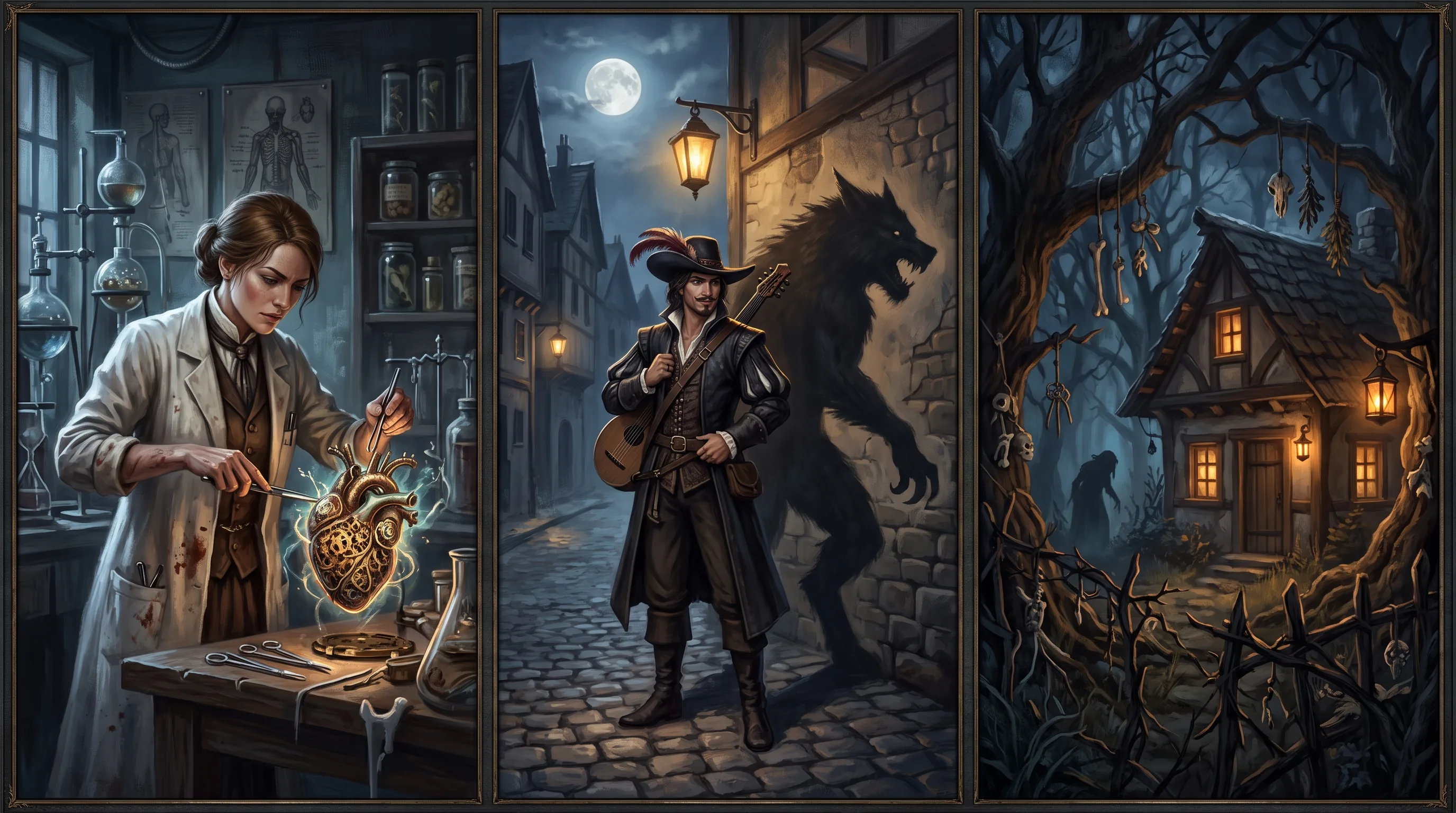
One of the most interesting and useful things Ravenloft: The Horrors Within gave us is a closer look at more of the Domains of Dread. Barovia is the best known, but there are so many other places to find rich NPC adversaries. We’re well into October, so it’s time to channel the spirits of the most wonderful time of the year and dive head first into a few more pockets of horror.
As I sit here with my pumpkin bread and warm apple cider, I’m excited to go through the most valuable thing (for me at least) the Ravenloft books have to offer. WotC gave us amazing settings, plot hooks, maps, and most importantly, Dark Lords. There’s a Dark Lord for every flavor of horror you can think of: classic gothic horror, ancient tombs and lost gods, cosmic psychological horror, even a witch out of folklore. Those last two are especially useful for the game I’m running at home. There’s plenty here to draw inspiration from, or to use straight at your own table.
A few elements of these Dark Lords are exceptionally useful for building your own villains across genres, so you can sprinkle horror themes into a campaign that isn’t a horror campaign.
Instead of the best-known Dark Lord, Strahd von Zarovich, let’s look at some lesser-known entities from the 5e and 5.5e Ravenloft books. I’m not going into obscene detail on every one. I’ll focus on a few that are interesting, a bit different, and worthy of stories in their own right.
Lamordia
An ode to strange science with a dash of steampunk, Lamordia is a frozen land of steel architecture and industrial creations. Homunculi, constructs, undead, clockwork: this is a domain that values knowledge and innovation over arcane means of creation. There’s a forest of rust that’s home to living metal creatures built from discarded machines, rivers poisoned by mining operations, and mummy burial sites.
Lamordia’s Dark Lord is Dr. Viktra Mordenheim, a doctor obsessed with finding the key to everlasting life. Her ultimate aim was the Unbreakable Heart, a device that wouldn’t bring the dead back as undead or constructs. It would defeat death itself, granting immunity to disease and old age. She ran inhumane experiments in her lab and created horrors of corrupted life by reanimating recently deceased “patients,” many of whom were procured while still alive to further her research. Viktra fell in love with Elise, a body snatcher and resurrectionist in her employ. When Elise began showing signs of a wasting disease, it only fueled Viktra’s drive to defeat death.
Viktra couldn’t finish the Unbreakable Heart in time. She threw herself deeper into the work for days and finally completed her masterwork, the one thing that could have spared Elise, who didn’t live to see it finished… or the monster that Viktra became.
She’s a somewhat sympathetic and, in a twisted way, well-meaning villain, with plenty of material to pull from if your players will let your big bad give a monologue. Mine usually won’t if they know something is even potentially an enemy, so a character like Viktra is excellent for entering a story with a reasonable-seeming motive while the true depths of her depraved experiments come out slowly. This kind of evil also does more systemic worldbuilding than a typical sword-and-board bad guy, because no single powerful person makes it possible. The people with the authority to stop her experiments are either blind to what’s happening, aware and apathetic, or worst of all, enabling it for their own selfish motives.
I recently added a reanimator character to my home game. Early on, one of the PCs lost his brother, who was the player’s original character, and he’s been haunted ever since by his failure to protect his naive younger brother. That gave me a great opportunity to dangle a McGuffin that could bring his brother back, with a layer of emotional growth or regression for the PC. We haven’t resolved it yet, but I for one am excited to see how it shakes out.
Kartakass
Who doesn’t love a good Jekyll and Hyde character? Harkon Lukas has a warm, welcoming face and a brilliant voice that can sing him into or out of nearly any situation. His unwavering charisma can rally a town to the point of revolution against the ruling class. He tells stories of the hardships he overcame to win the favor of the artists and creatives he admires. With all that bluster and attention-seeking, you’d assume he has nothing to hide. He’s an apex werewolf.
And the werewolf is a red herring. The real evil in Harkon is narcissism. He obsessively needs validation from his audience, and he uses everyone under his charm to fuel that need. He’s trapped in an endless cycle of triumph, duplicity, and depression. For all the inviting songs and the seemingly lavish lifestyle, nothing ever fills the hole of his ego.
Harkon makes a great villain because he can use social engineering, gaslighting everyone around him into turning on the party or one of its members. Use him as a traveling bard or as a makeshift community leader. Either way, he projects himself as open to scrutiny, which lulls the unwary into a false sense of security. At the first sign of disloyalty, though, his demeanor turns to disdain, and if you don’t follow the leader of the pack, your party is the next prey.
My suggestion with this kind of villain is to sow paranoia and doubt about who can be trusted early, and build slowly. With my group, I might mess with them by asking for random saving throws and pulling people aside one on one to tell them whether they passed or failed. I’d only do this if the people at the table know each other reasonably well, so nobody takes it personally. With the wrong group, it could cause real-life problems.
Tepest
It wouldn’t be the season of the witch without a classic hag. Quite possibly my favorite Dark Lord, at least for my Appalachian-folklore home game, is Mother Lorinda. Stumbling across a cozy wooden cabin in the woods isn’t rare, even in old, deep forests. Lush farmland and a cheerful celebration are a welcome sight for a tired adventuring party, especially after crossing blighted lands full of all manner of beasts.
The people of the small hamlet hold an old but still active woman in high regard. They seek her counsel on important matters and her remedies passed down through generations, and for good reason. She’s wise in the ways of the woods, healing, mending, and a great many other things. Mother Lorinda seems kind and benevolent toward her village, and the village seems idyllic. There’s no hunger or disease to speak of and the people look like they’ve been through a great deal, but those days are far from their minds. Some look like they survived a gruesome war or accident and lost limbs. Others are missing their left eyes… only the left eyes, though…
Mother Lorinda is a nice change of pace, basically just straightforward evil, there’s no compelling reason to empathize with her. She’s a hag who wants people sacrificed to her abomination of a “child” during a ritual time called the Tithe. She does grant boons, but the price is steep. Her most loyal followers give her their left eye.
Strangers get a very warm welcome in Lorinda’s village, because they’re a pleasant alternative to sacrificing your own family in the Tithe. That’s why a group of new adventurers would be such a welcome sight, and treated so well, right up until the annual “celebration” begins.
At the table, Mother Lorinda drops into pretty much any forest setting without changes. Get a little creative and you can swap the forest for any other terrain or campaign type and make her domain a town, a district, or a psych ward, keeping the bones: a benevolent overseer who demands sacrifice in return for safety.
A simple, effective plot hook is a parent whose child has been chosen for sacrifice and who needs help stopping it. When the party arrives, everyone looks down on them and brands them as mad or heretical, while the chosen child is treated as having received a great honor or obligation.
Final Thoughts
Viktra, Harkon, and Lorinda are all overshadowed in the Ravenloft books by Strahd, but each is worthy of their own story. I started writing this before Project_Lamordia was announced and released, which shows how much more there is in Van Richten’s Guide to Ravenloft and The Horrors Within. This spooky season, I encourage everyone to look a little deeper at the villain’s story. Sometimes they’re misguided and acting from a place of corrupted justice. Sometimes they’re just evil old people who want sacrifices for their own self-grandeur.
Happy Halloween, gang! Be safe, and as always remember, if you hear something calling your name in the Appalachian woods… no, you didn’t…